
If you’re building a menswear line or placing a bulk polo order for your brand, the polo shirt is probably on your list. It’s one of the best-selling categories in the men’s polo market for a reason: it sells across seasons, works for casual labels and corporate uniforms alike, and the production process is more straightforward than most outerwear. But “straightforward” doesn’t mean there aren’t decisions that will make or break your product.
This is what you need to know before you send that first inquiry to a polo shirt manufacturer.
Fabric: The Decision That Sets Your Price Point
Every men’s polo starts with a fabric choice, and that choice determines your unit cost, your retail positioning, and whether your customer reorders or moves on.
Cotton piqué is the industry standard for polo shirts and it’s standard for a reason. The textured diamond-knit structure gives the shirt body without stiffness, holds dye well, and photographs cleanly for e-commerce. Most brands producing men’s polos go with cotton piqué in the 200 to 240gsm range. Below 180gsm the shirt feels cheap and shows through. Above 260gsm you’re in heavyweight territory that works for premium lines but drives up your unit cost and makes the garment heavier than most customers expect from a polo.
A cotton piqué polo in 220gsm at 200 pieces will typically run $5.50 to $8 per unit from a Chinese manufacturer, depending on construction details and print or embroidery.
Linen polo shirts are a different market. Higher price point, seasonal appeal, more casual drape. The fabric wrinkles fast and doesn’t hold structure the way cotton piqué does, so the fit reads relaxed no matter how tailored the pattern is. If you’re targeting a resort or summer-focused customer, a linen polo makes sense. If you’re doing basics or corporate, skip it. Linen also costs more per meter than cotton, and the cutting waste is higher because the fabric is less stable on the table. Expect $8 to $12 per unit for a linen polo at similar order quantities.
Jersey knit cotton is what the budget end of the market uses. Smooth, thin, stretchy. The unit cost is the lowest (often under $4 for a basic jersey polo) but the garment degrades fast. Jersey collars curl after a few washes unless you add interfacing, which adds cost and partially defeats the purpose of going cheap. If your brand is positioned above fast-fashion, don’t use jersey. Your customers will notice.
Long sleeve polo shirts use the same fabrics but consume roughly 15 to 20% more material per unit. Factor that into your costing. Long sleeve polos sell well for transitional seasons and layering, and they’re underrepresented in most small brand lineups. If your competitors only offer short sleeve, adding a long sleeve option in the same fabric gives you a product extension at minimal additional development cost.
Color Range: What to Offer and What to Skip
New brands almost always want too many colors in their first run. Six or eight colorways sounds reasonable until you realize each color multiplied by five sizes means your 200-piece order is now split into 40 SKUs at 5 units each. That’s not a production run. That’s a sample pack.
Start with three to four core colors. Build from there once you have sales data.
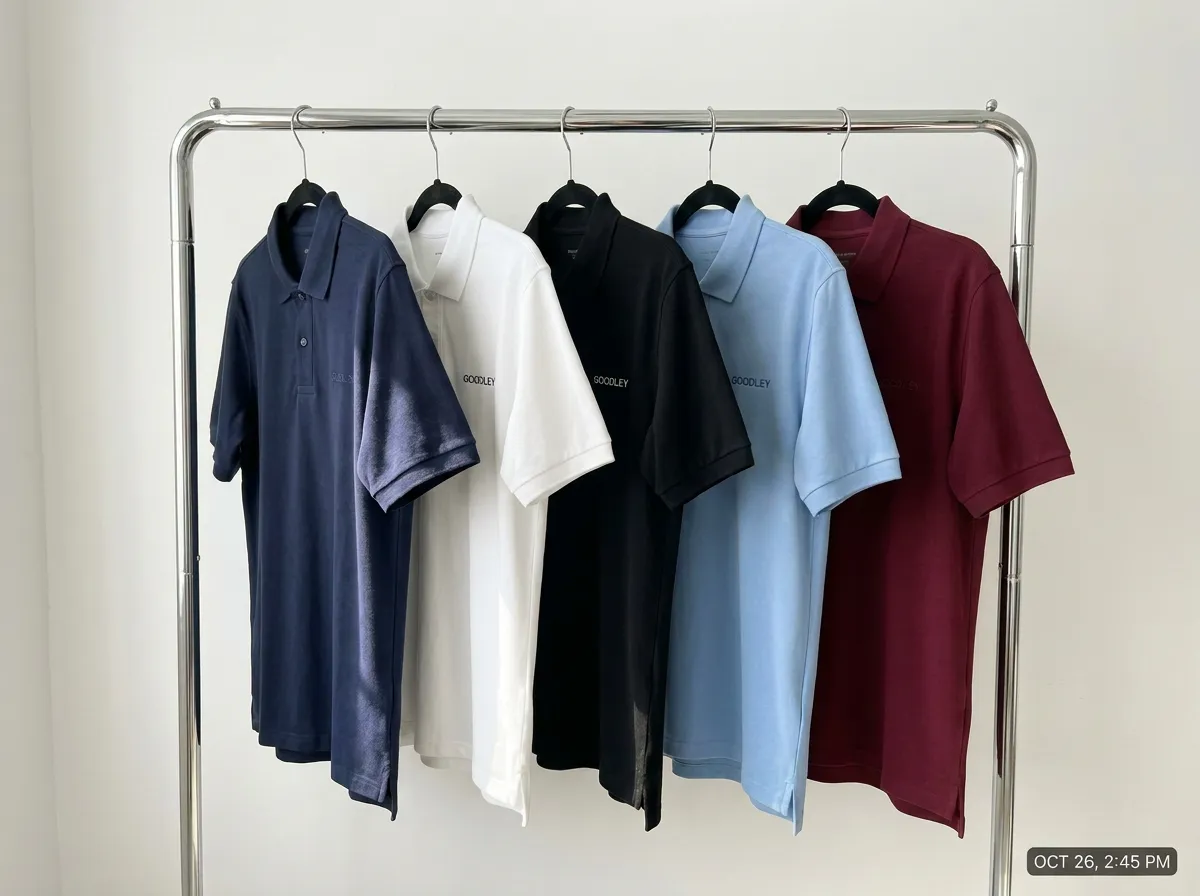
Black and white are non-negotiable. A black polo is the single most dependable SKU you’ll carry. It sells year-round, photographs well, works for both casual and uniform applications. A white polo is the summer default but it has a shorter usable life (collar yellowing, stain visibility) which actually helps your repurchase rate.
Navy belongs in every first run. If you’re only doing three colors, it’s black, white, navy.
After those three, your fourth color depends on who you’re selling to.
A pink polo has been a consistent performer in smart-casual and preppy-adjacent markets. Dusty pink or salmon, not neon. If your target customer wears chinos and loafers, pink will sell.
Red polos and striped polos carry stronger brand signals. Red works for sports-adjacent and streetwear lines. Stripes work for heritage and nautical positioning. Both are harder to move if your brand doesn’t have a clear identity yet.
Cream and yellow polos are seasonal. Cream has more staying power as a neutral (it pairs with nearly everything and reads slightly more premium than white). Yellow is riskier and works best in summer capsule drops, not year-round core ranges. The cost of dyeing doesn’t change by color, but leftover inventory in a niche color like yellow costs you more per unsold unit than leftover black.
The factory doesn’t care which colors you pick. What matters operationally is that each color meets the fabric mill’s minimum order per colorway, which is typically 100 to 200 meters of fabric depending on the mill. If your total order can’t fill those minimums across all your chosen colors, you’ll either need to use stock colors from the manufacturer’s existing fabric inventory or consolidate your range down.
Collar Construction Matters More Than You Think
The collar is the first thing a buyer notices when they pick up a polo shirt. It’s also where the gap between cheap and well-made becomes obvious after a few washes.
Three main types:
Ribbed knit collar. The classic. A separate piece of ribbed cotton knit attached to the neckline. Holds its shape well if the rib density is high enough. Most men’s polos use this. The quality difference comes from the rib’s gauge and whether it’s attached with a cover stitch (clean, flat) or a standard overlock (functional but less refined on the inside).
Self-fabric collar. Cut from the same material as the body. This gives a softer, more relaxed look but less structure. Common in designer and premium lines going for a casual aesthetic. Costs slightly less because there’s no separate collar component, but it requires careful interfacing decisions to prevent floppiness.
Woven collar. A stiff, button-down-shirt-style collar on a knit polo body. This is a style detail, not a construction upgrade. It reads more formal and works for corporate or smart-casual positioning. Adds complexity and cost because you’re mixing two fabric types in one garment.
Tell your manufacturer which collar type you want. If you don’t specify, they’ll default to ribbed knit because it’s the fastest and cheapest to produce. That might be exactly right for your brand. Or it might not. Either way, it should be your decision, not theirs.
Production Specs Your Manufacturer Needs From You
A polo shirt is a relatively simple garment but you still need to provide clear specifications. Here’s the minimum:
Fabric type and GSM. Not “cotton polo material” but “100% cotton piqué, 220gsm, combed cotton.” The more specific you are, the more accurate your quote will be.
Colorways with Pantone references or physical swatches. “Navy blue” means different things to different factories. Pantone 19-4052 means one thing everywhere.
Size range and measurements for each size. If you have a fit you like from another brand, send a physical sample to the factory. They can measure it and build the pattern from there.
Collar type, button count and material (2-button or 3-button, shell or resin), sleeve rib detail, side vents or no side vents, label type (woven or printed), and placket width.
Print or embroidery artwork in vector format (AI or EPS), with exact placement positions noted on a tech pack or at minimum a marked-up photo.
Missing any of these means your manufacturer will fill in the blank, and they’ll fill it with whatever’s standard or cheapest. That’s how you end up with a product that looks “close but not right.” (We covered this in detail in our article on why bulk orders don’t match samples.)
If you’ve never placed a bulk polo order before, start with one style, three colors, 100 pieces per color. That’s 300 total units, enough to test the market without overcommitting. Get the sample process right, nail the spec, and scale from there.
