MOQ 100PCS
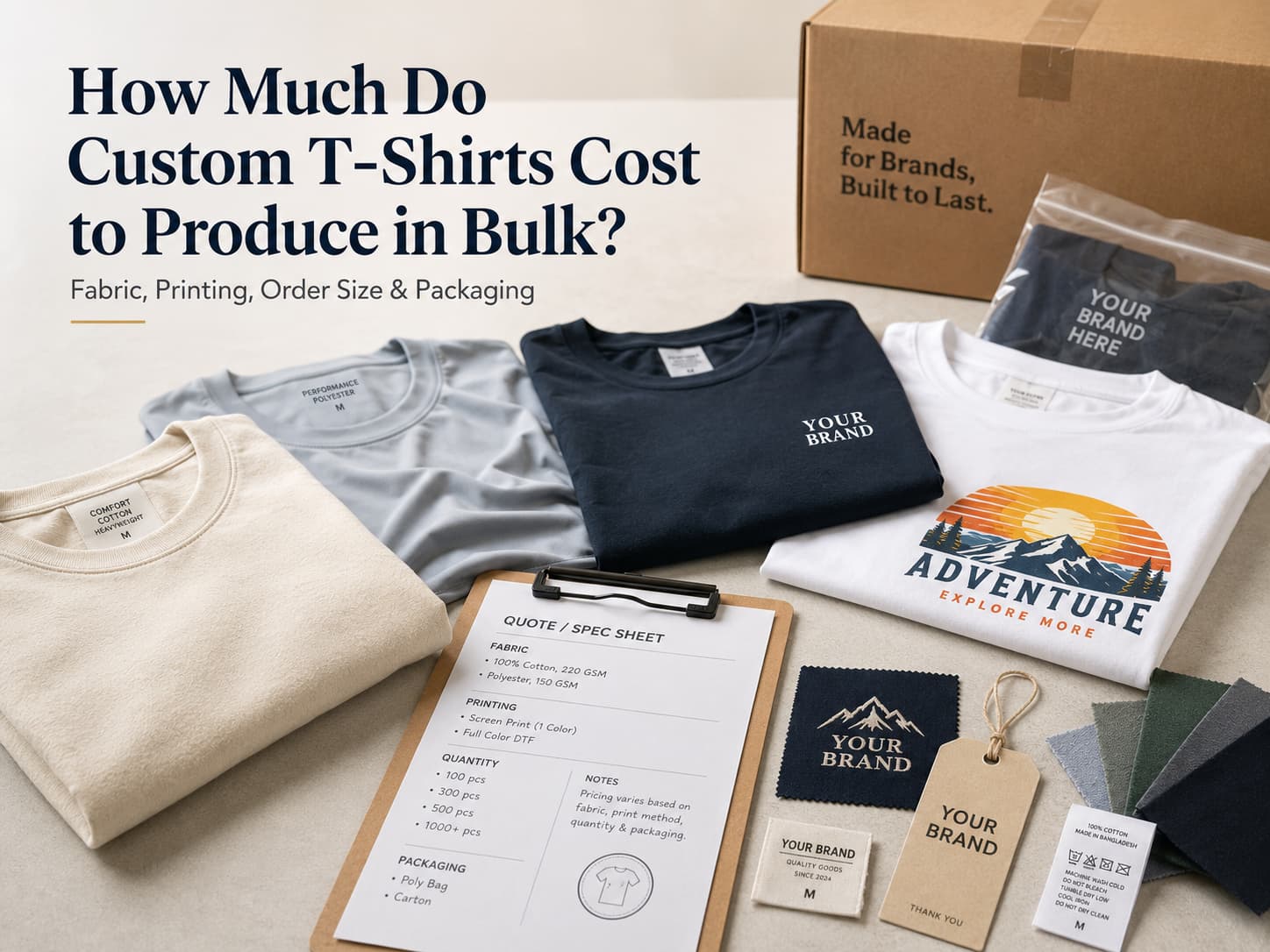
How Much Do Custom T-Shirts Cost to Produce in Bulk?
How much do custom t-shirts cost to produce in bulk? It depends. That sounds like a dodge, but it’s the only honest answer anyone in this business can give you. Two shirts sitting on the same table can have completely different production costs. A 160 GSM polyester tee for event giveaways and a 280 GSM combed cotton blank built for a streetwear drop are not the same product. Not even close.
The real question isn’t “how much” but “how much for what exactly.” Fabric choice, print method, order size, number of colors, packaging spec. Change any one of those and the quote changes with it. We get asked about pricing almost every week, and our answer is always the same: send the full spec, get a real number back. But if you’re still planning, still working out what you actually need, this breakdown will show you where the money goes and which decisions move the needle most.
Quick Reference: T-Shirt Production Cost Variables
Fabric weight range: 160 GSM (event/promo tee) to 280+ GSM (streetwear/premium blank)
Common print methods: Screen printing (best at scale), DTG (best under 200 pcs), embroidery (priced by stitch count)
MOQ for custom development: 100 pieces per style per color
Fixed costs that don’t scale: Pattern grading, screen setup, sample development
Most overlooked cost: Color/size matrix. Five colors across S to 5XL means significantly more production work than the same total quantity in one color
Sample timeline: Around 5 to 7 working days for a pre-production sample
Updated: August 2026
What most first-time buyers get wrong:
“Cotton t-shirt” is not a fabric specification. Two suppliers quoting you on “cotton t-shirts” are almost certainly pricing different fabrics. One might be using 180 GSM open-end cotton. The other 230 GSM ring-spun combed cotton. Completely different products, completely different costs. Pin down the GSM, yarn type, and finish before you compare any quotes.
Printing cost does not always drop with volume. Screen printing gets cheaper per unit as quantity goes up. DTG does not. Past around 200 pieces, DTG can actually cost more per shirt than screen print. Choosing the wrong method for your quantity is one of the most expensive mistakes we see people make.
The 5 Cost Layers in Every Custom T-Shirt
We think about t-shirt production cost in five layers. Not because five is a magic number, but because every quote we’ve put together breaks down into these same buckets. Understand what sits in each layer and you can read any quote from any supplier and know exactly what you’re paying for.
What most first-time buyers get wrong:
Cost Layer
What’s In It
What Moves the Number
Watch Out For
1. Fabric
Raw material per shirt
GSM, fiber type, special finishes (enzyme wash, garment dye)
Garment dyeing adds the most. It’s done after sewing, so fabric shrinkage means material loss.
2. Decoration
Print/embroidery per shirt
Method, color count, print locations, design complexity
Each print location (front, back, sleeve) is a separate setup. Three locations = three setups, not one.
3. Construction
Cutting, sewing, assembly
Shirt style (oversized needs more fabric), collar type, special stitching
Oversized cuts use more fabric per piece than fitted cuts at the same GSM.
4. Trims & Packaging
Labels, tags, poly bags, folding
Custom woven labels, hang tags, tissue paper, retail-ready packaging
Woven neck labels often have their own MOQ separate from the shirt order.
5. Fixed Overheads
Pattern, grading, samples, screen setup
Number of sizes, number of colors, revision rounds
These costs are the same for 100 shirts or 2,000 shirts. More volume just spreads them thinner.
Layers 1 and 2 usually make up the biggest chunk. Layer 5 hits hardest on small orders because it can’t be divided down.
Fabric: Where Most of the Money Lives
Ask ten garment people what drives production cost the most. Nine will say fabric. The tenth just forgot.
Start with the fiber. 100% combed cotton costs more than regular cotton. Polyester is cheaper per meter. CVC blends (chief value cotton, meaning more cotton than poly) sit in the middle. Tri-blends that include rayon or modal cost more again because that kind of fabric is harder to source at scale.
Then there’s weight. Higher GSM means more raw material in each shirt. Going from 200 GSM to 280 GSM across 500 units adds up fast. Simple math, but people overlook it when they fall in love with heavyweight blanks during the sampling phase.
Special finishes change the picture again. Pre-shrunk treatment, enzyme wash, garment dyeing. Each one adds labor. Garment dyeing is the most expensive of the three because it happens after sewing. The whole assembled shirt goes into the dye bath, which means fabric shrinkage is higher and some pieces don’t survive the process. You’re paying for the ones that don’t make it, too.
One thing we keep telling buyers: before you compare two quotes, confirm both suppliers are quoting the same fabric. “200 GSM combed cotton, 40s yarn count, pre-shrunk” is a spec. “Cotton tee” is not.
Decoration: Screen Print vs DTG vs Embroidery
Your design determines which method you should use. Not the other way around.
Screen printing works like this: each color needs its own screen, which creates a setup fee per color. Once those screens exist, running more shirts through them costs very little per unit. That’s why screen printing gets dramatically cheaper at higher volumes. For a one-color logo on 500 shirts, screen print is almost always the right call.
DTG (direct-to-garment) skips the screen setup entirely, which makes it attractive for small runs or photographic designs with lots of color gradients. But the per-unit cost doesn’t drop much with volume. Somewhere around 200 pieces, screen printing starts beating DTG on price for most designs. We generally suggest DTG for sample runs, special editions, or anything under 200 pieces.
For embroidery, pricing follows stitch count. A small chest logo runs a few thousand stitches. A full-back design might need tens of thousands and takes significantly longer to produce per piece.
Specialty techniques like puff print, foil stamping, discharge print, and flock transfer all add cost on top of standard screen printing. They can look great on the right design, but factor them into your budget from the start. Not after sampling.
Print placement is its own cost multiplier. Front only is one setup. Front and back is two. Add a sleeve print and that’s three separate production stages. Each location goes through its own screen prep, alignment, and quality check.
Quantity: The One Variable You Actually Control
Fixed costs like pattern making, size grading, and screen setup don’t change whether you order 100 or 2,000 shirts. More units just spread those fixed costs thinner.
The biggest per-unit drop happens between 100 and 300 pieces. Still noticeable between 300 and 500. Past 1,000, the curve flattens out because by that point the fixed costs have been diluted to almost nothing per shirt. You’re mostly paying for fabric and sewing time.
At our production base in Guangzhou, custom t-shirt development starts at 100 pieces per style per color. So if you want one design in three colors, that’s 300 pieces total minimum. For existing styles where you’re just adding your logo or a custom neck label, there’s no minimum.
Colors and sizes complicate things more than people expect. Split an order of 500 across five colors and sizes S through 5XL. Now you need different fabric dye lots, revised cutting layouts for each size, size-by-size grading, and more complex sorting and packing at the end. Same total piece count. Significantly more production work.
Labels, Tags, and Packaging: Small Line Items That Stack Up
Nobody budgets for these properly the first time. They seem tiny on a per-piece basis but they add up across an order fast.
Custom woven neck labels need a separate production run with their own minimum order quantity. Branded hang tags, printed care labels, custom poly bags, tissue paper wrapping, stickers. Each item adds a little. Together they shift the per-unit cost noticeably.
Retail-ready folding (shirt folded around a cardboard insert, slipped into a branded bag) costs extra labor per shirt. On 500 shirts that small per-piece add-on becomes a real line item. Ask your supplier whether the base quote already includes labels and packaging, or whether those are separate with their own minimums. This is where quotes from different suppliers get hard to compare. Some bundle everything. Some itemize.
Three Costs That Catch First-Time Buyers Off Guard
Samples aren’t free. Before bulk production starts, you need a pre-production sample. That means buying fabric, cutting, sewing, and shipping a single piece internationally. Sample fees vary by style and include international courier. They’re refunded when you place the bulk order at the agreed quantity. But it’s a real upfront cost. Budget for it.
Revisions add time and money. The first sample is rarely perfect. The collar sits a bit high. The body runs long by half an inch. The print color on fabric looks different from what you saw on screen. A revision round means cutting and sewing again, which adds days. We always tell people: send detailed reference photos and, if you have one, a tech pack. The more specific your input, the fewer rounds you’ll need. That’s not a sales pitch. It’s just how sampling works.
Shipping is a separate budget line. Production cost and shipping cost are two different things. Sea freight from Guangzhou to the US takes roughly 3 to 5 weeks. Air freight is faster but costs considerably more. Duties depend on your destination country and the fabric composition. Let your supplier know the destination country and fabric blend upfront so they can flag any duty considerations early. Here’s how our production and shipping process works from start to finish.
How to Get a Quote That's Actually Useful
Vague requests get vague estimates. The more specific your brief, the more accurate the number you get back.
You don’t need a professional tech pack. Annotated reference photos work. Grab a photo of a shirt that’s close to what you want, mark up the changes (“make this collar 1cm lower,” “add this logo here, 8cm wide”), and send it with:
- Product type and style (crew neck, V-neck, oversized, fitted)
- Target fabric weight and composition (or describe the hand feel you want)
- Quantity broken down by color and size
- Decoration method and placement(s)
- Labeling and packaging requirements
- Destination country and target delivery date
That’s enough for any decent supplier to give you a line-by-line breakdown instead of a ballpark range.
How to Get a Quote That's Actually Useful
How much does it cost to make t-shirts in bulk?
There’s no single number. Cost depends on fabric type and weight, decoration method, quantity, number of colors and sizes, and packaging requirements. The best way to get a real answer is to send your full specification to a supplier and ask for an itemized quote.
What's the minimum order for custom t-shirts?
For fully custom development (your fabric, your pattern, your design), 100 pieces per style per color is standard. If you’re working with an existing blank and just adding a logo or custom neck label, the minimum is usually much lower or doesn’t apply.
Is screen printing or DTG cheaper for bulk orders?
Screen printing almost always wins on price above around 200 pieces because the setup cost gets spread across more units. DTG is cheaper for very small runs because there’s no screen setup fee. For complex photo-style prints in small quantities, DTG makes sense. For logo work at volume, screen print.
Why is my quote different from what I saw online?
Online prices usually don’t include your specific fabric, print complexity, packaging, labels, or shipping. They’re ballpark numbers based on generic specs. A real quote factors in your actual spec sheet, your actual quantity, and your actual destination.
Are sample costs refundable?
Policies vary by supplier. At Goodley, sample fees are refunded once you place the bulk order at the agreed quantity. The sample itself requires real fabric, labor, and international shipping, so most manufacturers charge something upfront.
What makes the biggest difference in cost per shirt?
Fabric weight and type. Moving from a 160 GSM polyester to a 280 GSM combed cotton blank changes the material cost per shirt significantly. After that, the biggest swing factor is quantity, because fixed overheads like pattern grading and screen setup get spread thinner across more units.
Need a cost estimate for your custom t-shirt order? Send us the product type, quantity per color and size, decoration method and placement, fabric preference, and destination country. We’ll come back within 24 hours with a line-by-line quote. No ballpark ranges.
jessie@gzgoodley.com | WhatsApp: +86 137 6079 4016

Jessie Tan
Newsletter Updates
Enter your email address below and subscribe to our newsletter